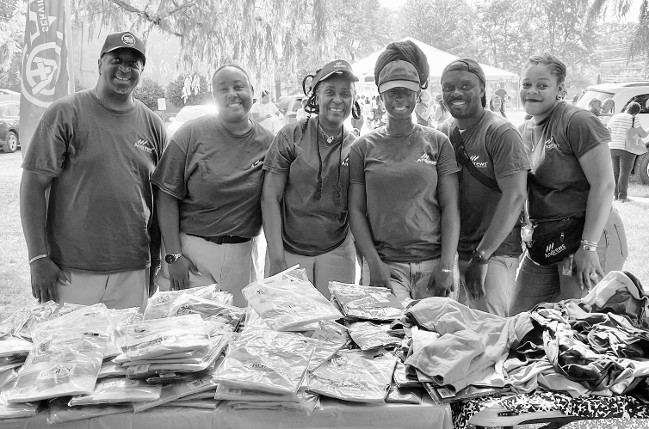
 Photo courtesy Andrews Federal Credit Union
Andrews Federal provided 800 school uniform packages at the event.
Andrews Federal Credit Union Provides 800 School Uniform Packages to Support Students and Families in Prince George’s County
By NATALIE TATE
Andrews Federal Credit Union
SUITLAND, Md. (Oct. 1, 2026)—Andrews Federal Credit Union recently partnered with Prince George’s County Council Member Edward P. Burroughs III to help families prepare for the new school year with essential supplies, clothing and community resources.
The Back to School event in Fort Washington, Md., brought families together for an afternoon of food, fun and back-to-school support. Students and families living in District 8 of Prince George’s County had access to school supplies and shoes, haircuts and styling, and other resources to ease the transition into a new school year.
Andrews Federal provided 800 school uniform packages at the event. Each package included essential school clothing items, including unisex khaki pants, polo shirts for boys and girls, socks and undergarments.
“Preparing for a new school year should be an exciting time for students and families, not a source of financial stress,” said Damita Robinson, Chief Operating Officer for Andrews Federal Credit Union. “We are proud to partner with Council Member Burroughs to remove financial barriers for families and ensure students walk proudly and confidently into a new school year.”
Andrews Federal has continued to expand partnerships and educational resources as part of the credit union’s commitment to supporting local communities. Other recent initiatives include support for local youth and family programs, a major donation to fund Prince George’s County’s 311 On The Go program, and the credit union’s annual college and summer camp scholarship awards.
Founded in 1948, Andrews Federal Credit Union has grown to serve more than 163,000 members in the District of Columbia, Maryland, Virginia, New Jersey, and military installations in central Germany, Belgium, and the Netherlands. For more information about Andrews Federal, visit andrewsfcu.org.
TOP OF PAGE
M-NCPPC Highlighted as National Gold Medal Finalist for Parks and Recreation Excellence
M-NCPPC Recognized Nationally as a Top Four Parks and Recreation Agency
By PRESS OFFICER
M-NCPPC
PRINCE GEORGE’S COUNTY, Md. (Oct. 1, 2026)—The Maryland-National Capital Park and Planning Commission (M-NCPPC), serving Montgomery and Prince George’s Counties, has been recognized as a 2026 National Gold Medal Finalist by the National Recreation and Park Association (NRPA) and the American Academy for Park and Recreation Administration (AAPRA).
M-NCPPC was recognized in the Class I category, which recognizes agencies serving populations greater than 400,001. The recognition places M-NCPPC among four finalists nationally, highlighting the Commission’s continued commitment to excellence in parks and recreation, innovation, environmental stewardship, quality programming, and meaningful community engagement.
Established in 1927, M-NCPPC is approaching its centennial in 2027 with nearly a century of service to the residents and communities of Montgomery and Prince George’s Counties. The Commission has earned the National Gold Medal six times, in 1973, 1977, 1983, 1984, 2003, and 2015, making M-NCPPC the only six-time National Gold Medal recipient. This year’s finalist recognition adds another chapter to that longstanding legacy and reflects the continued dedication of the people who plan, protect, maintain, program, and invest in parks and recreation opportunities across the two counties.
“M-NCPPC is proud to create spaces and programming that inspire connection, equity, and opportunity for all,” said Chair of M-NCPPC, Artie Harris, Montgomery County Planning Board Chair. “We’re honored to be recognized alongside so many outstanding organizations, and this recognition reflects the dedication of our staff and partners who work every day to make a difference in our community.”?
“Being recognized as a National Gold Medal finalist is a tremendous honor for M-NCPPC and the communities we serve,” said Kevin A. Anderson, Chair of the Prince George’s County Planning Board. “It reflects the strength of our parks and recreation system and the impact it has on communities across the region.”
Darius A. Stanton, Director, M-NCPPC, Department of Parks and Recreation, added: “Being named a National Gold Medal finalist reflects the dedication of our staff and their commitment to serving our communities every day. We are proud of this recognition and remain focused on helping our communities Live More, Play More.”
“Being recognized as a Gold Medal Award finalist is a tremendous honor and a reflection of the dedication of our staff, volunteers, and community partners who provide exceptional programs and facilities,” said Miti Figueredo, Director of Montgomery Parks. “We’re proud to be recognized among the nation’s leading park systems and grateful to everyone who helps make Montgomery Parks a place where our community can thrive.”?
The National Gold Medal Finalist designation recognizes M-NCPPC’s continued commitment to excellence in parks and recreation management, including long-range planning, resource management, environmental stewardship, community engagement, and innovative programming. M-NCPPC’s bi-county structure brings together the expertise and resources of Montgomery Parks and the Department of Parks and Recreation in Prince George’s County to serve communities across the region.
The 2026 National Gold Medal finalists competed in the Class I category alongside Baltimore City Recreation and Parks, Hillsborough County Parks & Recreation, and Palm Beach County Parks and Recreation. Baltimore City Recreation and Parks was named the 2026 Class I Grand Plaque recipient during the 2026 National Recreation and Park Association (NRPA) Annual Conference in Philadelphia.
Created in 1927, The Maryland-National Capital Park and Planning Commission (M-NCPPC) has endeavored to improve the quality of life for all of the citizens of the bi-county area it serves and of the communities in which these citizens live, work and raise their families.
With over 29,000 acres of parkland, trails, athletic fields, playgrounds, and more, the M-NCPPC, Department of Parks and Recreation in Prince George’s County provides an award-winning park system through progressive, quality, innovative leadership and a commitment to its community and environment. www.pgparks.com.
Montgomery Parks manages 417 parks and more than 37,000 acres of parkland.
www.MontgomeryParks.org
TOP OF PAGE
Quantum Companies Expand in Maryland
State and business leaders promoted the growth of quantum computing companies in Maryland at the recent opening of Microsoft’s new quantum center in Discovery District Maryland.
By CHARLOTTE ORMOND
Capital News Service
RIVERDALE, Md. (Oct. 1, 2026)—State and business leaders promoted the growth of quantum computing companies in Maryland at the opening of Microsoft’s new quantum center in Riverdale, advancing the state’s goal to become the “Capital of Quantum.”
“Quantum is sort of an emerging technology, so it has a lot of promise,” Gretchen Campbell, the associate vice president for quantum research and education at the University of Maryland, told Capital News Service.
Campbell joined others at the Microsoft center’s grand opening last Tuesday. The center will house technology designed to advance quantum research and bring together global partners to collaborate in Maryland. Unlike traditional computers, quantum computers use quantum physics to process information much faster and solve complex problems. While many quantum computers are still in the prototype stage, the technology is rapidly advancing, experts say.
Campbell said she hopes the new center will advance quantum science and give University of Maryland students opportunities to work with scientists and learn about the developing technology.
Gov. Wes Moore, who spoke at the opening, said Microsoft’s decision to build this center in Maryland is a major accomplishment for the state and will attract quantum researchers and business leaders to the area.
“The world has descended upon College Park,” Moore said. “They came here because they believed. They came here because they saw the future being written in College Park.”
The opening of the center comes a year after Moore’s announcement of the partnership with Microsoft at the 2025 Quantum World Congress.
Campbell said other major technology companies have announced plans to establish headquarters in Maryland. In September, Riverlane, a developer of quantum error correction technology, said it will locate its U.S. headquarters to Discovery District Maryland. The district is a 150-acre research park in Prince George’s County that houses more than 60 research organizations and federal agencies, including Microsoft’s new center. QuEra Computing, a neutral-atom quantum computing company, also said in September it will open an office in the Discovery District.
Moore said that in under two years, partners at the University of Maryland, in the private sector and across all levels of government have pledged over $500 million in investments to support the growth of quantum research in Maryland. The initiative aims to raise $1 billion in investments over the next five years.
“This is international. This is real,” said Rep. Glenn Ivey, D-Md., who also spoke at the opening. “This is a major piece putting us on, not just the map, but the globe…It’s not an overstatement, really, to say that the direction that the world takes, maybe even the fate of the world, is going to hinge on what happens in these areas.”
TOP OF PAGE